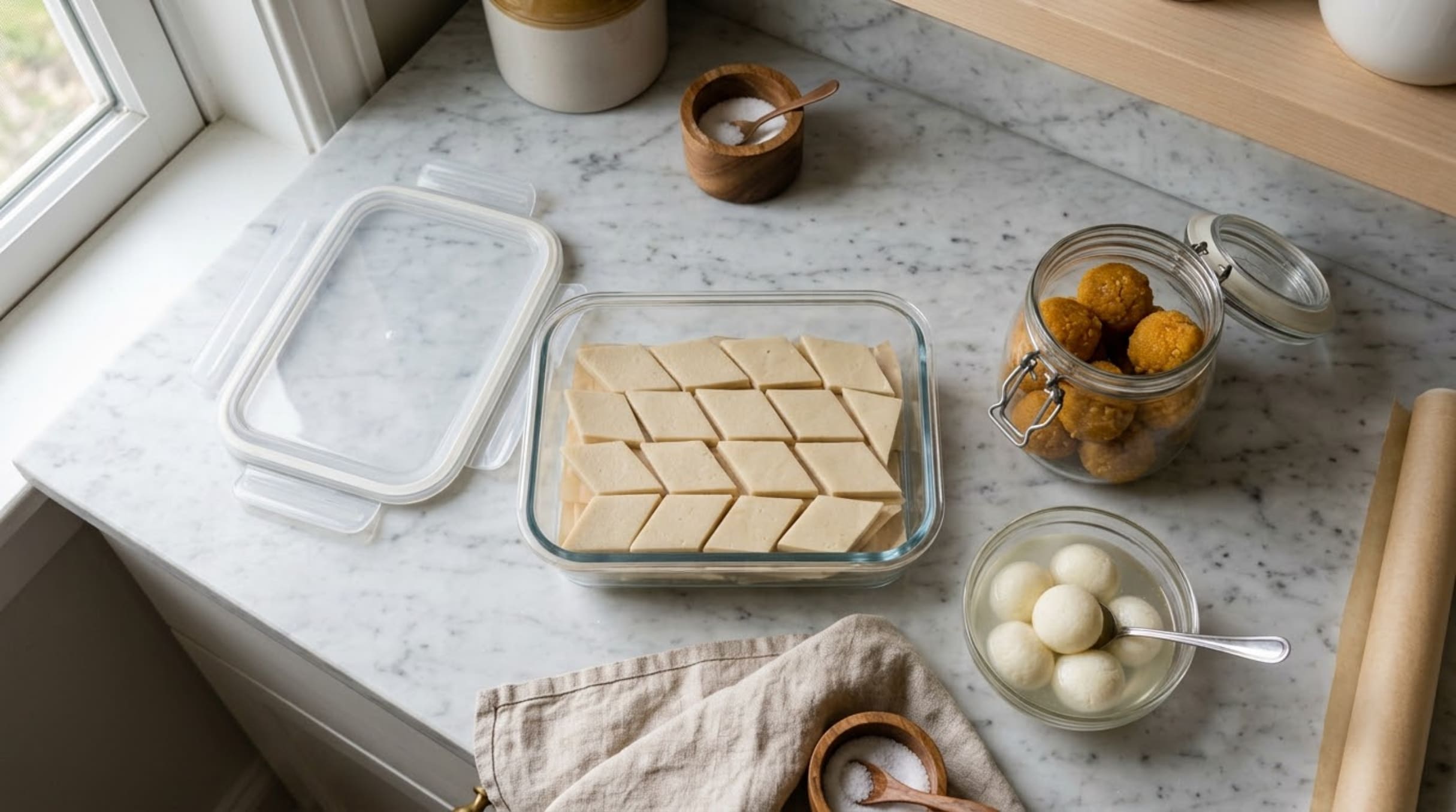












Most of the mithai sold in Australia comes from the North Indian tradition. Milk reduced down to khoya over an hour, then worked into barfi, peda and ladoo. Dense, dry, cut into pieces.
Bengali sweets are built the opposite way. Milk is split rather than reduced, and what you get is soft, wet, and usually sitting in syrup or thickened milk. The two traditions barely overlap in method, and anyone who grew up with one often finds the other strange on first encounter.
If you have moved from Kolkata to Melbourne and spent a few Durga Pujas trying to explain to people why rasgulla is not just a sweet dumpling, this is the guide to send them.
Chhena: the thing everything is made from
Fresh whole milk is brought to the boil and split with something acidic, usually lemon juice or whey from a previous batch. The solids separate from the liquid. Those solids, drained and then kneaded, are chhena.
It is closely related to paneer and made almost identically, with one important difference. Paneer is pressed hard to expel water and hold its shape. Chhena is drained but never fully pressed, so it stays soft, and it is then kneaded at length until the grain breaks down and the texture turns smooth and slightly elastic.
That kneading is where Bengali sweet-making is either good or not. Under-knead it and the rasgulla cracks apart in the syrup. Over-knead it and they come out tight and rubbery. There is a window, and finding it takes years rather than a recipe.
Because chhena is made from fresh milk hours earlier, everything built on it is perishable. This is why Bengali sweets have never travelled the way barfi has, and why finding good ones outside a city with a Bengali community is difficult.
The main varieties
Rasgulla
The one everyone knows. Balls of kneaded chhena boiled in light sugar syrup until they roughly double in size and turn spongy the whole way through.
A good rasgulla should compress almost completely when you press it and then spring back. It should be white, not yellowed, and the syrup should be thin and clear rather than heavy. Served cold, usually two or three to a bowl with a little syrup.
The debate over whether rasgulla originated in Bengal or Odisha ran for years and reached a formal conclusion of sorts through geographical indication filings, with both states holding GI tags for their own distinct versions. Anyone from either state will tell you the matter is not actually settled.
Cham cham
Oblong rather than round, denser than rasgulla, and cooked in a heavier syrup so the texture is chewier. Often rolled in desiccated coconut or khoya, and frequently stuffed.
Cham cham comes in a browned version, where the syrup is caramelised, and a pink version that is lighter and sweeter. The brown is more traditional. The pink photographs better, which explains a good deal about which one sells.
Rasmalai
Flattened chhena discs, poached and then soaked in thickened milk flavoured with saffron and cardamom, topped with pistachio and almond.
Rasmalai is the least intimidating Bengali sweet for someone new to the category, because the thickened milk reads as familiar in a way that clear sugar syrup does not. It is also the one most likely to appear on an Australian restaurant dessert menu.
Served cold, in its milk, with the milk being at least half the point.
Sandesh
The dry one. Chhena worked with sugar and shaped, sometimes flavoured with jaggery in winter, sometimes pressed into moulds. No syrup at all.
Sandesh is the most refined thing in the Bengali repertoire and the hardest to do well, since there is nowhere to hide. It is also the least available in Australia, for the same reason.
Mishti doi
Sweetened yoghurt, set with caramelised sugar, traditionally in a clay pot that draws out moisture and firms it. Somewhere between a dessert and a dairy product.
Bengali sweets and Durga Puja
For Bengalis, Durga Puja is the festival, in the way Diwali is for much of the rest of India. Sharad Navratri in 2026 runs from 11 to 19 October, with Durga Puja falling in the final days of that and Dussehra on 20 October.
Sweets do specific work across those days. Bhog is offered at the pandal. Boxes are exchanged between households. And on Vijaya Dashami, the last day, the custom is to feed sweets to elders and to anyone you have embraced in greeting, which in a busy pandal means a great many sweets.
Melbourne, Sydney and Perth all run substantial community Durga Pujas now, generally organised by Bengali cultural associations. Demand for chhena sweets in those two weeks is sharp and short, and most stores underestimate it. If you are planning ahead for the festival season, our Diwali sweets guide covers timing and quantities.
Buying and serving in Australia
A few practical points.
They are sold in syrup and need refrigeration. This is the main reason Bengali sweets appear less often in gift boxes. They are not shelf-stable and they cannot be posted. Buy them to eat within a few days, and use our store locator to find the nearest stockist.
Serve cold. Rasgulla and rasmalai are both meant to be eaten chilled, straight from the fridge. Rasmalai in particular is unpleasant at room temperature.
Do not freeze them. Freezing destroys the sponge structure of chhena. What thaws out is dense and rubbery, and the change is not reversible.
Serve with the liquid. The syrup and the milk are part of the dish rather than packing material. A rasmalai served without its milk is a different and worse thing.
Check the colour. Good rasgulla is white or very pale cream. A yellowish tinge usually means the chhena was not fresh or the syrup was overcooked.
Full storage timings for all of these sit in our Indian sweets shelf life guide.
Our Range
Browse Our Full Product Range
750+ authentic Indian food products — sweets, snacks, ready-to-heat meals and more. Available at Indian grocery stores across Australia.
View All ProductsHow they differ from North Indian sweets
Worth setting out plainly, since the two get grouped together on the same shelf.
| Bengali sweets | North Indian sweets | |
|---|---|---|
| Base | Chhena (curdled milk) | Khoya (reduced milk) |
| Texture | Soft, spongy, wet | Dense, dry, firm |
| Served | Cold, in syrup or milk | Room temperature |
| Sweetness | Lighter, syrup-carried | Heavier, sugar-bound |
| Shelf life | 3–5 days, refrigerated | 5–14 days |
| Travels | Poorly | Well |
| Examples | Rasgulla, rasmalai, sandesh | Kaju katli, peda, ladoo |
Neither tradition is better. They solve different problems. Khoya sweets were built for a climate and an era without refrigeration, which is why they keep. Chhena sweets assume you are eating them near where they were made.
Frequently asked questions
What is chhena? Fresh milk curdled with an acid such as lemon juice, then drained and kneaded until smooth. It is the base of almost all Bengali sweets. Similar to paneer but not pressed, so it stays soft.
What is the difference between rasgulla and rasmalai? Rasgulla is a round chhena ball in light sugar syrup, served in that syrup. Rasmalai is a flattened chhena disc soaked in thickened, sweetened milk with saffron and cardamom. Rasmalai is richer; rasgulla is lighter.
What is the difference between rasgulla and cham cham? Rasgulla is round and spongy in a thin syrup. Cham cham is oblong, denser and chewier, cooked in a heavier syrup, and often coated in coconut or khoya and stuffed.
Can Bengali sweets be frozen? No. Freezing collapses the spongy structure of chhena permanently, and what thaws out is dense and rubbery. Refrigerate and eat within three to five days instead.
Do Bengali sweets need refrigeration? Yes. They are made from fresh curdled milk and sit in syrup or milk. They should be refrigerated from purchase and eaten within a few days.
Are Bengali sweets vegetarian? Yes. They are made from milk, sugar, and flavourings such as saffron, cardamom and nuts. They contain dairy, so they are vegetarian but not vegan.
Why are Bengali sweets harder to find than other Indian sweets? Because they are perishable. Chhena is made from fresh milk hours before the sweet is finished, and the result keeps for days rather than weeks. Barfi and peda can be made in bulk and shipped; rasgulla cannot.
More from Amba Foods
- Indian sweets and mithai range: the full sweets catalogue, made fresh in Melbourne
- Browse all products: sweets, snacks, ready-to-heat meals and more
- Gift boxes: boxed mithai for Durga Puja, Diwali and every other occasion
- Find a store near you: stockists across Australia
- Indian sweets in Melbourne: the wider guide to buying mithai locally
- How fresh mithai is made in Melbourne: what happens in our kitchen
- Diwali sweets guide for Australia: what to buy and when to order
- Diwali gift boxes in Australia: choosing and sending a box
- Kaju katli vs almond barfi vs kesar peda: the North Indian side of the comparison
- About Amba Foods and our manufacturing
Ordering
We make chhena sweets in Melbourne, in our own manufacturing facility, and supply grocery stores, restaurants, caterers and event businesses across Australia through our wholesale, food services and distribution arms. Because the shelf life is short, orders around Durga Puja and Diwali are best placed with a few days’ notice. You can contact us directly or read more about Amba Foods.
Wholesale Supply
Stock Amba Foods Products in Your Store
Wholesale supply for retailers, restaurants and caterers across Australia. Competitive pricing, reliable delivery.
Wholesale EnquiryGet in Touch
Have Questions? We're Here.
Call us on 1300 790 350 or send us a message — our team responds within 1 business day.
Contact Us