









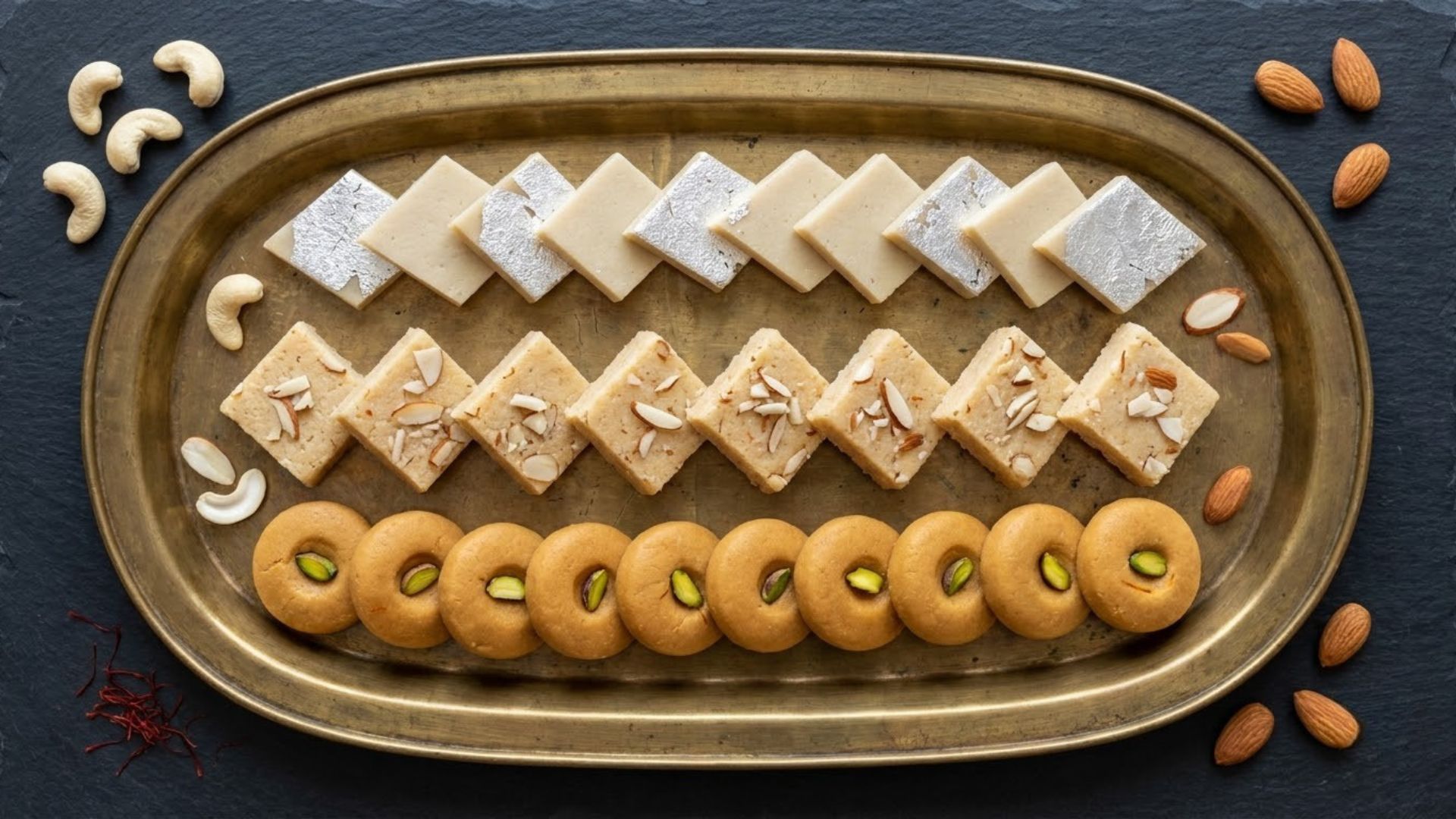
Three sweets account for most of what goes into Diwali gift boxes in Australia. Kaju katli, almond barfi and kesar peda. They sit at similar price points, they all keep for about a week, and most people choose between them on habit rather than on any actual difference.
There are real differences, and they matter depending on who the box is going to.
The short answer
If you want the recommendation without the reasoning:
Kaju katli for colleagues, neighbours and anyone you do not know well. It is the safest choice and nobody has ever been disappointed to receive it.
Almond barfi for people who eat mithai regularly and will notice something that is not the default.
Kesar peda for elderly relatives, for boxes going interstate, and for the puja thali.
The rest of this covers why.
What each one actually is
Kaju katli
Cashews ground to a paste, cooked with sugar syrup to a specific consistency, rolled thin and cut into diamonds. Usually finished with edible silver varak.
There is almost nothing else in it. No flour, no thickener, no dairy in the traditional recipe. The texture is smooth and slightly dense, and the flavour is mild enough that people who find Indian sweets too sweet generally get along with it.
Our kaju katli is the single most ordered sweet we make during Diwali week, which tells you more about buying habits than about the sweet.
Almond barfi
Same method, almonds instead of cashews. That one swap changes more than it sounds like it should.
Almonds carry more fat and a stronger flavour, so almond barfi is denser, nuttier, and reads as less sweet even at the same sugar level. The colour is warmer, closer to cream than white. It also holds together better, which matters if the box is being carried around.
Kesar peda
A different process entirely. Milk is reduced down to khoya over an hour or more, then worked with sugar, saffron and cardamom, shaped into small discs and pressed with a thumbprint or a pistachio.
Kesar peda is a milk sweet rather than a nut sweet. Denser than both katli and barfi, with a caramelised depth from the khoya and a floral note from the saffron. If you want the darker, longer-cooked version, mathura peda takes the khoya further.
Side by side
| Kaju Katli | Almond Barfi | Kesar Peda | |
|---|---|---|---|
| Base | Cashew | Almond | Reduced milk (khoya) |
| Texture | Smooth, thin, dense | Dense, slightly coarse | Firm, fudgy |
| Sweetness | Mild | Mild to medium | Medium |
| Flavour | Clean, subtle | Nutty, rich | Saffron, cardamom, caramel |
| Shelf life (room temp) | 5–7 days | 5–7 days | 5–7 days |
| Shelf life (chilled) | 2 weeks | 2 weeks | 2 weeks |
| Travels well | Yes | Yes, best of the three | Yes |
| Needs refrigeration | No | No | No |
| Contains dairy | No (traditional recipe) | No (traditional recipe) | Yes |
| Nut allergen | Cashew | Almond | Usually pistachio garnish |
| Relative price | Highest | High | Moderate |
| Recognised by non-Indian recipients | Very | Moderately | Less |
Choosing by recipient
Colleagues, neighbours, clients
Kaju katli. The reason is recognition rather than quality. Someone who has never eaten Indian sweets before will find katli approachable, and someone who has will recognise it as the premium option. It is the choice that carries no risk.
Almond barfi is arguably the better sweet, but it requires the recipient to know enough to appreciate the difference.
Elderly relatives
Kesar peda. Softer to eat, less sweet on the finish, and the saffron and cardamom are the flavours most associated with home for anyone who grew up in North India. Peda is also easier to portion into small servings.
Family who eat mithai often
Almond barfi, or a mix. People who buy sweets year-round have had a great deal of kaju katli. A box with barfi and peda in it registers as a decision rather than a default.
Boxes going interstate or by post
Kesar peda first, almond barfi second. Peda is the most robust of the three and arrives looking like it did when it left. Kaju katli travels fine but the silver varak smears against packaging, so it needs to be laid flat with a separator.
The puja thali
Kesar peda. Saffron carries auspicious associations, and peda is the traditional offering sweet across much of North India. Small quantities, so cost is not the deciding factor.
Someone with a nut allergy
None of these three. Kaju katli and almond barfi are nut sweets outright, and peda is usually garnished with pistachio and made in kitchens that handle nuts. Kalakand or milk cake are the safer direction, though cross-contamination in any Indian sweet kitchen is a genuine consideration worth raising with the supplier.
The price question
Kaju katli is the most expensive of the three, and the gap is not small. Cashews cost more than almonds, and both cost considerably more than milk.
That premium is priced into the cultural meaning. Sending kaju katli signals a certain level of spend, which is exactly why it dominates corporate gifting and why it is the default for relationships where you want the gesture to register clearly.
Kesar peda gives you the best ratio of quality to cost. If you are assembling twenty boxes rather than two, weighting toward peda and using katli as the accent item makes the budget work without the boxes looking cheap.
Putting them in one box
The three work well together, which is not a coincidence. They cover different textures, different bases and different colours.
A balanced 500g box: roughly 200g kaju katli, 150g almond barfi, 150g kesar peda. That reads as generous, gives the recipient variety, and keeps the shortest shelf life in the box at around a week.
Two things to get right. Keep the katli flat and separated so the varak stays intact. And put the peda at the edges rather than the centre, since it holds its shape under slight pressure better than the cut sweets do.
Prefer it ready-made? The Marigold Tile Mithai Box – Kaju Katli holds three rows of silver-leaf kaju katli, the Gold Octagon Mithai Box sets kaju katli among three other classic mithai, and the Royal Black Dry Fruit & Mithai Box puts katli and barfi alongside cashews and almonds. Our guide to the best Diwali gift boxes in Melbourne covers the rest of our gift box range.
Our Range
Browse Our Full Product Range
750+ authentic Indian food products — sweets, snacks, ready-to-heat meals and more. Available at Indian grocery stores across Australia.
View All ProductsAn honest note on the default
Kaju katli became the standard Diwali gift for reasons that have as much to do with price signalling as with taste. It is a very good sweet. It is also the one people choose when they have not thought about it.
If the box is going to someone you actually know well, spending five minutes on what they would prefer produces a better result than defaulting to the most expensive option. Plenty of people would rather receive good kalakand than more katli.
Frequently asked questions
Which is better, kaju katli or almond barfi? Kaju katli is milder and more universally recognised. Almond barfi is nuttier and denser, and holds up better in transit. For gifting to people unfamiliar with Indian sweets, katli is safer. For people who eat mithai regularly, barfi is the more interesting choice.
How long does kaju katli last? Five to seven days at room temperature in mild weather, and around two weeks refrigerated. Keep it out of direct sunlight and let it come to room temperature before opening a chilled box, otherwise condensation makes the surface tacky.
Is kesar peda vegetarian? Yes. It is made from reduced milk, sugar, saffron and cardamom. It contains dairy, so it is vegetarian but not vegan.
Which of these three is best for posting interstate? Kesar peda, followed by almond barfi. Both are firm enough to survive handling. Kaju katli travels well too but needs to be packed flat so the silver varak does not smear.
Do any of these need refrigeration? None of them do for short periods. In Australian November weather, refrigeration extends all three to around two weeks. Peda holds up best unrefrigerated.
Which is cheapest? Kesar peda, generally by a clear margin, since milk costs less than cashews or almonds. Kaju katli is the most expensive of the three.
What is the silver on kaju katli? Edible silver leaf, called varak. It is food-safe, traditional, and adds no flavour. It is decorative and signals a premium sweet.
Ordering
We make all three in Melbourne and supply grocery stores, restaurants, caterers and event businesses across Australia.
For Diwali 2026, which falls on 8 November, custom box orders are best placed by mid-October. Corporate and bulk orders should go in through September.
Wholesale Supply
Stock Amba Foods Products in Your Store
Wholesale supply for retailers, restaurants and caterers across Australia. Competitive pricing, reliable delivery.
Wholesale EnquiryGet in Touch
Have Questions? We're Here.
Call us on 1300 790 350 or send us a message — our team responds within 1 business day.
Contact Us