












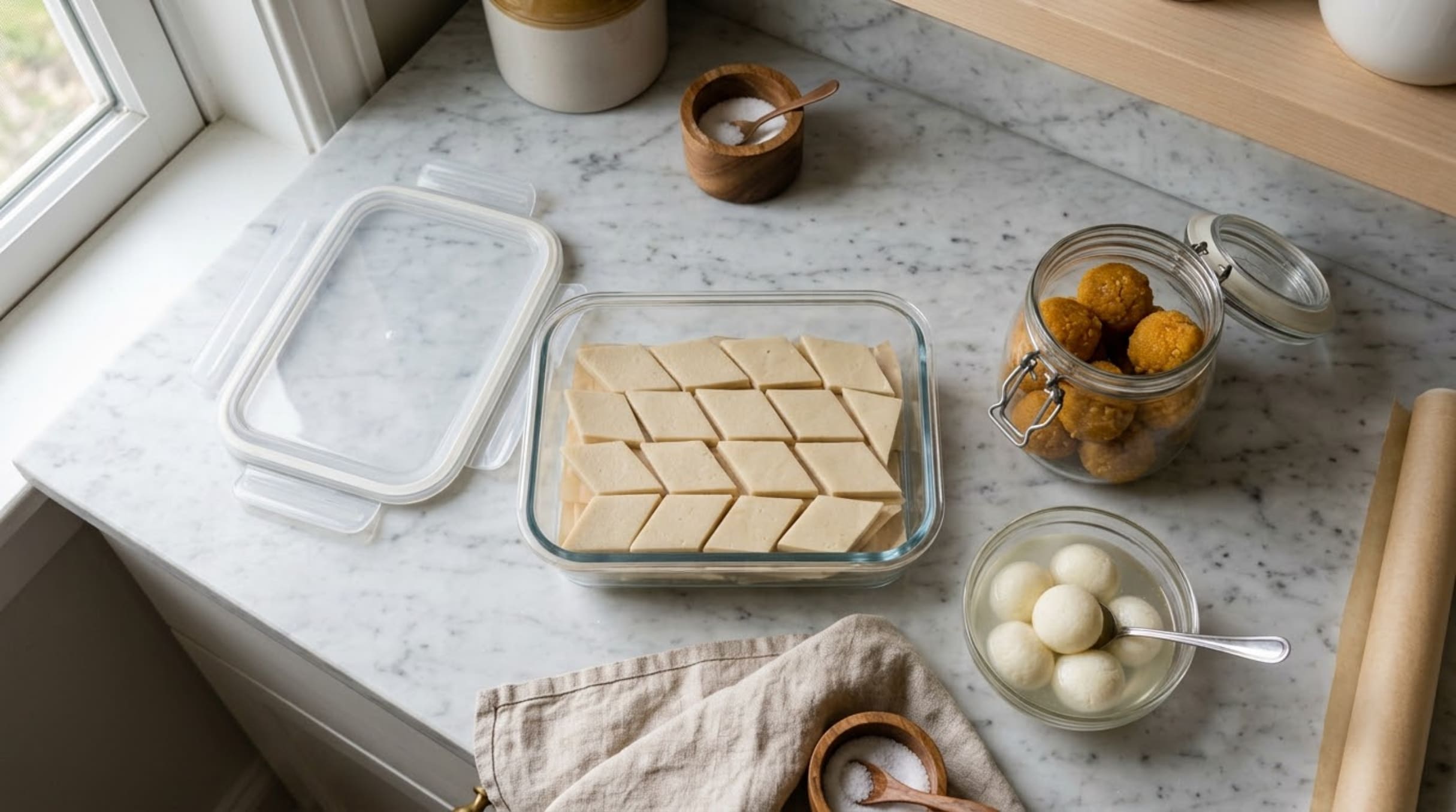
A box of mithai arrives on Saturday. By Tuesday the kaju katli has gone tacky, the varak has stuck to the lid, and the kalakand smells faintly sour. Nothing was wrong with the sweets. They were stored badly.
Indian sweets are dairy confectionery for the most part, and they behave like dairy. Shelf life varies enormously between types, the storage rules are different for each, and Australian conditions add their own problems. This covers all of it.
Shelf life by sweet
Room temperature here assumes a normal indoor Australian home, roughly 20 to 25 degrees. Hotter than that and everything shortens.
| Sweet | Room temperature | Refrigerated | Freezer |
|---|---|---|---|
| Dry fruit panjiri | 3–4 weeks | 2 months | Not needed |
| Gujia | 2 weeks | 3 weeks | 2 months |
| Kesar peda | 5–7 days | 2 weeks | 1 month |
| Mathura peda | 7–10 days | 2–3 weeks | 1 month |
| Kaju katli | 5–7 days | 2 weeks | 1 month |
| Kaju kesar katli | 5–7 days | 2 weeks | 1 month |
| Almond barfi | 5–7 days | 2 weeks | 1 month |
| Motichoor ladoo | 4–5 days | 10 days | 1 month |
| Milk cake danedar | 3–4 days | 1 week | 3 weeks |
| Kalakand | 2–3 days | 5–6 days | 2 weeks |
| Gulab jamun (in syrup) | 3–4 days | 1 week | 1 month |
| Angoori gulab jamun | 3–4 days | 1 week | 1 month |
| Cham cham | Refrigerate only | 4–5 days | Not recommended |
| Rasgulla | Refrigerate only | 4–5 days | Not recommended |
| Rasmalai | Refrigerate only | 3–4 days | Not recommended |
| Gajar halwa | 1 day | 4–5 days | 1 month |
Why the range is so wide
Three things decide how long a sweet lasts: moisture, dairy content and sugar.
Sugar is a preservative. It binds water so bacteria cannot use it, which is why heavily syrup-soaked and heavily sugared sweets outlast lightly sweetened ones. This is also why the sweets people describe as too sweet are usually the ones that keep.
Moisture works the other way. Kalakand is deliberately moist and grainy, and that moisture is exactly what shortens it to two or three days. A drier sweet like mathura peda, where the khoya has been cooked much further, lasts twice as long for the same reason.
Fresh chhena is the shortest-lived base of all. Rasgulla, cham cham and rasmalai are made from milk curdled hours earlier, and no amount of syrup fixes that. They need refrigeration from the moment they are made.
At the other end, dry fruit panjiri contains almost no free moisture. Roasted flour, ghee, nuts and sugar. It keeps for weeks on a shelf and is the only sweet on this list you can genuinely forget about for a fortnight.
How to store each type
Cut sweets: katli, barfi
Airtight container, single layer, parchment or baking paper between layers if you must stack them. Room temperature is fine for the first week.
The silver varak on kaju katli transfers onto anything it touches, so never press cling film directly onto the surface. It also lifts if the sweet sweats, which brings us to the biggest mistake people make in Australia.
Peda and shaped milk sweets
The most forgiving category. Airtight container, room temperature, out of sun. Kesar peda does not need refrigerating in a normal week and is slightly better unrefrigerated, since chilling firms it up more than the texture wants.
Ladoo
Airtight, room temperature, not stacked more than two deep. Motichoor ladoo is held together by syrup, and weight from above compresses the lower ones into a flat mass.
Soft milk sweets: kalakand, milk cake
Refrigerate after the first day. These are the shortest-lived sweets most households buy, and they are worth buying in small quantity for immediate eating rather than putting in a box that sits.
Milk cake danedar holds slightly longer than kalakand because it is cooked further and drier at the edges.
Syrup sweets: gulab jamun
Store gulab jamun and angoori gulab jamun submerged. The syrup is what protects them, and any part left above the surface dries and hardens. Airtight container, refrigerated after two days, and reheat gently before serving rather than eating cold.
Chhena sweets
Refrigerate immediately, keep in their syrup or milk, and eat within four days. Do not freeze. Freezing collapses the spongy structure of chhena and what thaws out is dense and rubbery. This is the one category where the freezer is not an option. Our Bengali sweets guide explains why chhena behaves this way.
Halwa
Gajar halwa is the most perishable thing on this list at room temperature because it is wet and full of milk. Refrigerate the same day. It freezes very well, which is useful, and reheats in a pan with a splash of milk.
Four mistakes that spoil sweets early
Condensation
The most common failure in Australia and the one nobody expects. Taking a chilled box out of the fridge, opening it straight away, and putting it back creates moisture on the surface of every sweet inside. Katli goes sticky, varak lifts, ladoo weeps.
Let a refrigerated box sit closed on the bench for twenty minutes before opening it. That single habit does more for sweet quality than anything else here.
Storing dry and syrup sweets together
Dry sweets absorb moisture from syrup sweets sitting beside them. A gujia stored next to gulab jamun goes soft within a day. Separate containers, even inside a larger gift box.
Heat in transit
A box on a car dashboard or in a boot on a warm Melbourne afternoon can reach fifty degrees. Fresh milk sweets do not recover from that. During Diwali week, when people drive between three or four houses in an evening, this accounts for a lot of ruined mithai.
Take the box inside at each stop. It sounds excessive and it is the difference between a good box and a wasted one.
Freezing the wrong things
Katli, barfi, peda, ladoo, gujia and halwa all freeze acceptably if wrapped well. Chhena sweets do not. Kalakand technically survives freezing but loses the grain that makes it worth eating.
To freeze properly: wrap each piece or portion, then put it in an airtight container, and thaw in the refrigerator overnight rather than on the bench.
How to tell when a sweet has gone
Milk sweets sour before they mould, and the smell is the first signal. If a kalakand or peda smells sharp or faintly cheesy, it is done.
Katli and barfi go tacky on the surface and then hard. Tacky is still edible. Hard with a dull grey cast is not.
Syrup sweets develop a cloudy or stringy syrup. Clear syrup means fine, cloudy means throw it out.
Visible mould on any of them means the whole container, not just the affected piece. Sugar syrup and khoya carry spores through a batch faster than people assume.
A note on buying fresh
All of the above assumes sweets made recently. A sweet that has already spent a week in distribution before it reaches you starts its clock well into the countdown.
This is the practical argument for buying from somewhere that makes mithai locally rather than shipping it in. The timings in this guide are from the day of making, and the distance between a Melbourne kitchen and a Melbourne kitchen table is measured in hours. We have written about how fresh mithai is made if the process is of interest, or use our store locator to find a stockist near you.
Our Range
Browse Our Full Product Range
750+ authentic Indian food products — sweets, snacks, ready-to-heat meals and more. Available at Indian grocery stores across Australia.
View All ProductsFrequently asked questions
How long do Indian sweets last at room temperature? It depends on the type. Dry sweets like panjiri and gujia keep for two to four weeks. Nut sweets like kaju katli and almond barfi last five to seven days. Soft milk sweets like kalakand last two to three days. Chhena sweets such as rasgulla need refrigeration from the start.
Can you freeze Indian sweets? Most of them, yes. Katli, barfi, peda, ladoo, gujia and halwa all freeze for around a month if wrapped individually and kept airtight. Chhena sweets including rasgulla, cham cham and rasmalai should not be frozen, since freezing ruins their spongy texture permanently.
Do Indian sweets need to be refrigerated? Not all. Katli, barfi, peda and ladoo are fine at room temperature for several days in normal Australian indoor conditions. Kalakand, milk cake, gulab jamun and all chhena sweets should be refrigerated.
Why did my kaju katli go sticky? Almost always condensation. Opening a cold box in a warm room puts moisture on the surface. Let the box come to room temperature before opening it, and store it airtight away from any syrup sweets.
How long does rasgulla last? Four to five days refrigerated, kept submerged in its syrup. Rasgulla should never be left at room temperature for more than a couple of hours, and it does not freeze successfully.
How can I tell if mithai has gone off? Milk sweets sour before they show mould, so smell is the first indicator. A sharp or cheesy smell means discard. Syrup that has turned cloudy or stringy is another sign. Any visible mould means discarding the whole container.
How should I store a Diwali gift box? Work to the shortest shelf life in the box. If it contains kalakand or any chhena sweet, refrigerate the whole box and eat within a few days. If it is all katli, barfi and peda, airtight at room temperature is fine for a week. For choosing a box in the first place, see our Diwali gift boxes guide or browse our gift boxes.
More from Amba Foods
- Indian sweets and mithai range: the full sweets catalogue, made fresh in Melbourne
- Browse all products: sweets, snacks, ready-to-heat meals and more
- Gift boxes: boxed mithai with the shelf life to match the occasion
- Find a store near you: stockists across Australia
- Bengali sweets in Australia: rasgulla, cham cham and rasmalai explained
- How fresh mithai is made in Melbourne: what happens in our kitchen
- Indian sweets in Melbourne: the wider guide to buying mithai locally
- Diwali gift boxes in Australia: choosing and sending a box
- Kaju katli vs almond barfi vs kesar peda: which keeps and travels best
- About Amba Foods and our manufacturing
Ordering fresh
We make mithai in Melbourne, in our own manufacturing facility, and supply grocery stores, restaurants, caterers and event businesses across Australia through our wholesale, food services and distribution arms. You can contact us directly or read more about Amba Foods.
Wholesale Supply
Stock Amba Foods Products in Your Store
Wholesale supply for retailers, restaurants and caterers across Australia. Competitive pricing, reliable delivery.
Wholesale EnquiryGet in Touch
Have Questions? We're Here.
Call us on 1300 790 350 or send us a message — our team responds within 1 business day.
Contact Us

