










There is a moment in making khoya where the milk stops being milk. It has been in the pan for well over an hour, reducing, the halwai scraping the base in slow figure-eights so nothing catches. The colour shifts from white to ivory to a faint fawn. The smell changes — sweeter, nuttier, closer to caramel than dairy. And then it pulls away from the sides of the pan in one mass, and it’s khoya.
You cannot rush that. You cannot particularly automate it either, at the scale most Indian sweets are made. What you can do is start early, use good milk, and have someone at the pan who has done it ten thousand times before.
That’s most of what happens in our Melbourne kitchen.
Why fresh matters more with mithai than almost anything else
Indian sweets are, for the most part, dairy confectionery. Khoya, chhena, paneer, malai, ghee. That base is what gives mithai its texture and its short, honest shelf life.
A kalakand made this morning is grainy, moist, and slightly warm at the centre. The same kalakand four days later is denser and drier, and by a week it has lost the thing that made it worth eating. This isn’t a flaw. It’s what fresh dairy does.
Which means the distance between the kitchen and the customer is the single biggest variable in how good mithai tastes. A sweet made in Melbourne on Tuesday and delivered Wednesday is a fundamentally different product from one made overseas, shipped, warehoused and put on shelf weeks later — even if the recipe is identical.
That’s the entire argument for local manufacture, and it isn’t a marketing argument. It’s a dairy chemistry one.
The four things everything is built from
Almost every sweet in a mithai case traces back to one of four bases.
Khoya (mawa)
Whole milk reduced over heat until most of the water is gone. Depending on how far you take it, you get three grades — soft and moist for gulab jamun, firmer for barfi, and granular for milk cake, where the graining is deliberately encouraged and is the whole point of the sweet.
Roughly five litres of milk becomes one kilo of khoya. That ratio is why good mithai is expensive and why cheap mithai usually isn’t made with khoya at all.
Chhena
Milk curdled with acid, then drained. Where khoya is milk with the water taken out, chhena is milk with the whey taken out — a different texture entirely, soft and slightly springy.
Chhena is the Bengali tradition: rasgulla, cham cham, rasmalai. The kneading stage decides everything. Under-kneaded chhena makes rasgulla that cracks in the syrup; over-kneaded makes them rubbery. There’s a window, and finding it is experience rather than instruction.
Sugar syrup
Judged the traditional way, by thread. Cool a drop between finger and thumb, pull them apart, and count the threads. One thread for soaking sweets, two for setting barfi, and further for harder work.
A thermometer will tell you the temperature. It won’t tell you what the syrup will do once it meets khoya at a particular humidity on a particular Melbourne afternoon. Both get used.
Ghee and besan
The roasting base for motichoor ladoo, mysore pak and the whole besan family. Besan roasted in ghee has a narrow window between raw and burnt, and the finish line is smell rather than colour — the point where it turns unmistakably nutty.
A day in the kitchen
Sweets production runs backwards from delivery. If a store needs it Thursday morning, the kitchen is on it Wednesday well before dawn.
Early morning — milk in, khoya on. This is the long job and it dictates the rest of the day, so it starts first.
Mid-morning — chhena work. Curdling, draining, kneading, shaping. Chhena sweets have the tightest timeline of anything made, so they’re made closest to dispatch.
Late morning — syrup, setting, and the barfi family. Khoya-based mixtures are poured into trays, levelled, and left to set to the point where they’ll cut cleanly.
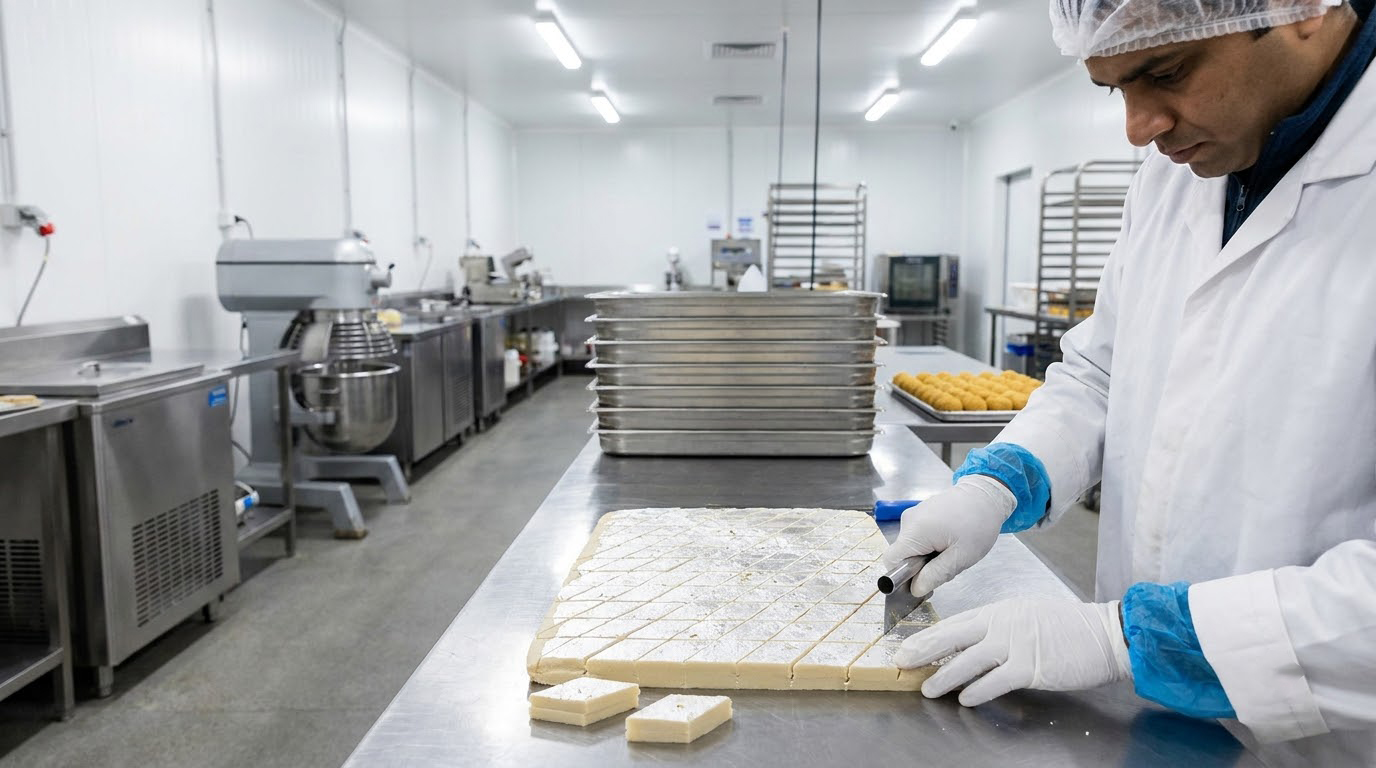
Afternoon — cutting and garnishing. Kaju katli cut into diamonds, silver varak laid on, pistachio and almond scattered, kesar peda shaped and pressed.
Late afternoon — packing, labelling, cold storage, loading. Out the door the next morning.
The whole cycle is compressed deliberately. Every hour between making and eating is an hour the product is getting worse.
What’s changed, and what hasn’t
It’s easy to romanticise this and pretend nothing has moved since 1950. Plenty has.
Food safety has. Commercial dairy handling in Australia means temperature logs, allergen controls, traceability on every batch and documented cleaning schedules. Traditional method, modern compliance — and the compliance genuinely matters when you’re producing fresh dairy sweets at volume in a warm climate.
Consistency has. Weighing rather than eyeballing, standard batch sizes, controlled setting times. A customer who liked your kaju katli in March expects the identical thing in November.
Scale has. Larger pans, mechanical mixing for some stages, cold storage that didn’t exist for most of this tradition’s history.
The judgement calls haven’t. When the khoya is done, when the chhena is kneaded enough, when the syrup is right — those are still made by a person looking at the pan. No one has automated them, and at this scale no one particularly should.
Our Range
Browse Our Full Product Range
750+ authentic Indian food products — sweets, snacks, ready-to-heat meals and more. Available at Indian grocery stores across Australia.
View All ProductsWhat this means if you’re stocking mithai
For grocers, restaurants and caterers, local production changes the commercial equation in a few ways.
Shorter lead times. Ordering days ahead rather than weeks. Around Diwali, when demand forecasting is close to guesswork, that flexibility is worth a great deal.
Fresher stock on shelf. More sell-through, less shrinkage. Fresh dairy sweets that sit are dead money.
Smaller minimum orders. No container-load economics, so a smaller store can carry a wider range rather than committing deeply to a few lines.
Adjustable through festival season. Between Ganesh Chaturthi in September and Diwali in November, demand moves week to week. Local production means the order can move with it.
The same applies to our Diwali gift boxes, which are made in Melbourne rather than shipped in, so the mithai inside is as fresh as the loose sweets on the counter.
We’ve been making Indian sweets in Melbourne since 2007 and supply grocery stores, restaurants, caterers and event businesses across Australia — alongside a distributed range of snacks, frozen lines and pantry goods on the same delivery.
Wholesale Supply
Stock Amba Foods Products in Your Store
Wholesale supply for retailers, restaurants and caterers across Australia. Competitive pricing, reliable delivery.
Wholesale EnquiryThe part that doesn’t scale
Every so often someone asks whether the traditional method is worth it, given what modern food manufacturing can do.
The answer is that the traditional method isn’t nostalgia — it’s just what produces the result. Khoya reduced slowly over an hour tastes different from khoya made fast. Chhena kneaded by hand behaves differently in syrup. These aren’t sentimental claims; they’re differences you can taste in a side-by-side, which is roughly how every one of our recipes got settled in the first place.
There are parts of making mithai that scale well, and we use every one of them. The rest is a person at a pan, and it stays that way.
Get in Touch
Have Questions? We're Here.
Call us on 1300 790 350 or send us a message — our team responds within 1 business day.
Contact Us