











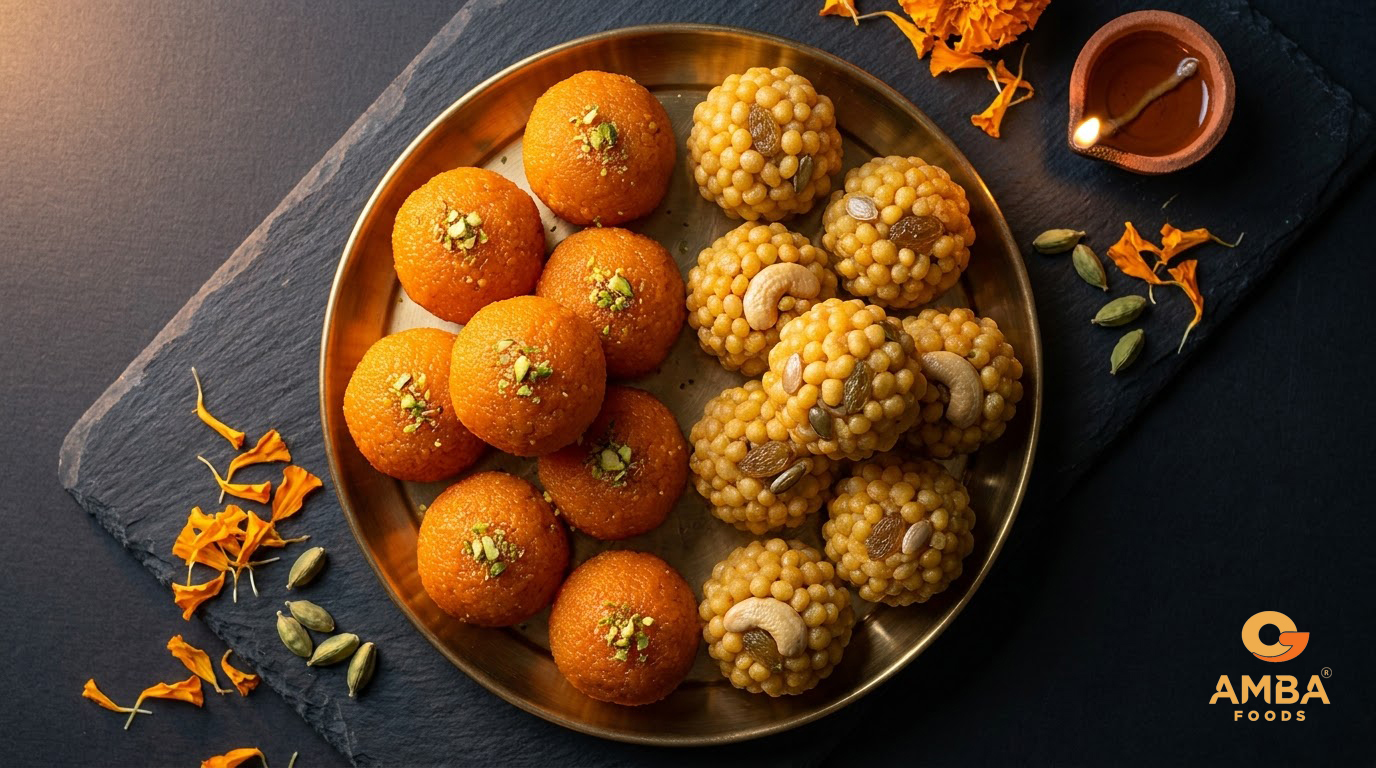
Put a motichoor ladoo and a boondi ladoo side by side on a plate and most people would call them the same sweet. Both are round, golden and made from the same few ingredients. Bite into them, though, and the difference is obvious within a second.
Motichoor almost dissolves. Boondi holds together, with a little chew and a texture you can feel.
Which one you choose for Diwali comes down to who you are giving it to and what they will do with it. Here is how to tell them apart.
The short version
| Motichoor ladoo | Boondi ladoo | |
|---|---|---|
| Made from | Gram flour (besan) batter | Gram flour (besan) batter |
| Size of the pearls | Very fine, almost like grains | Larger, distinct drops |
| Texture | Soft, moist, melts in the mouth | Firmer, slightly chewy, holds its shape |
| Typical additions | Cardamom, saffron, melon seeds | Cardamom, cashews, raisins |
| Feels like | Delicate and rich | Homely and traditional |
| Best for | Gifting, guests, children | Puja, temple offerings, travel |
How both are made
Both ladoos start the same way. A batter of gram flour and water is poured through a perforated ladle, called a jhara, into hot ghee or oil. The drops fry into tiny crisp balls called boondi.
The boondi go straight into warm sugar syrup, usually scented with cardamom and sometimes saffron, and soak it up. While the mixture is still warm, it is pressed by hand into rounds. That last step is quick work. Leave it too long and the syrup sets and the ladoos will not hold.
The difference comes down to one thing: the size of the drops.
Motichoor
Moti means pearl, and choor means crushed. Motichoor is made with a thinner batter pushed through a ladle with very small holes, so the boondi come out tiny, almost like grains. Those fine pearls soak up more syrup relative to their size, which is why motichoor is so soft and why it seems to melt rather than chew.
Motichoor is the ladoo of North Indian sweet shops. It is the one handed out for exam results, new jobs, new babies and new homes, and the one most people picture when they hear the word ladoo. Our motichoor ladoo comes in orange, and we also make a yellow motichoor.
Boondi
Boondi ladoo uses a slightly thicker batter and a ladle with larger holes. The drops are bigger, so each pearl stays distinct and the finished ladoo has more bite. Cashews and raisins are often mixed through.
Boondi ladoo is everywhere, but it has a special place in temples. The most famous ladoo prasadam in India, served at Tirupati, is built on boondi with ghee, cashews and cardamom. In many North Indian homes, boondi is also the sweet offered to Hanuman on Tuesdays.
Which one to give
For neighbours, colleagues and guests: motichoor
Motichoor is the more universally loved of the two, and the softer texture suits people who do not eat Indian sweets often. It also looks festive: bright, glossy and generous on a plate.
Our Golden Ladoo Window Box holds 12 motichoor ladoo in a yellow floral window box, which makes it one of the easiest Diwali gifts to give in numbers.
For puja, temple visits and elders: boondi
Boondi ladoo has the more traditional feel, and its firmer texture means it keeps its shape on a puja thali through a long evening. For elders who grew up with temple prasad, it often tastes like home.
Our Crimson Boondi Ladoo Box holds 12 boondi ladoo in a crimson brocade window box, and suits a gift taken to a puja or to grandparents.
For children: either, in small portions
Children tend to love both. Motichoor is softer for very young ones, while boondi is less messy to hold.
For a gift that has to travel: boondi
If the box is going in the car for a long drive, or being carried between several houses on Diwali night, boondi holds up better. Motichoor is softer and can compress if boxes are stacked.
For a mixed crowd: both
At a party or a large family gathering, a plate with both gives people a choice, and makes for a good conversation starter with guests who have never noticed there is a difference.
Other ladoos worth knowing
Ladoo is a whole family of sweets, not just these two. In our range you will also find navratan boondi ladoo, Jodhpuri ladoo, rose dry fruit ladoo and coconut petha ladoo. Each has its own texture and flavour, and a mix makes a lovely tray.
Keeping ladoo fresh
Both motichoor and boondi ladoo are held together by sugar syrup, which makes them more forgiving than milk sweets.
- At room temperature: around four to five days in an airtight container.
- In the fridge: up to around ten days. Let the container come back to room temperature before you open it, or condensation will make the ladoos sticky.
- Stacking: do not stack more than two layers deep. The weight flattens the ladoos at the bottom, especially motichoor.
- Heat: keep the box out of direct sun and out of a parked car.
Our Indian sweets storage guide covers every major sweet in more detail.
A note for fasting days
Because both are made from gram flour, motichoor and boondi ladoo are not suitable for most Navratri and vrat fasts, which usually exclude pulses and their flours. Our Navratri food guide covers what is usually allowed.
Our Range
Browse Our Full Product Range
750+ authentic Indian food products — sweets, snacks, ready-to-heat meals and more. Available at Indian grocery stores across Australia.
View All ProductsLadoo for Diwali from Amba Foods
We make fresh ladoo in our Melbourne kitchen, and both of our ladoo boxes are part of our Diwali gift box range, alongside mithai boxes, dry fruit boxes and luxury trunks. For help choosing between them, see our guide to the best Diwali gift boxes in Melbourne.
To order, call 1300 790 350 or send an enquiry. Diwali falls on Sunday 8 November 2026, and ordering early is the best way to get the boxes you want.
Frequently asked questions
What is the difference between motichoor ladoo and boondi ladoo? Both are made from gram flour batter fried into small drops and bound with sugar syrup. Motichoor uses very fine drops, so it is soft and melts in the mouth. Boondi uses larger drops, so it is firmer, slightly chewy and holds its shape.
Which is softer, motichoor or boondi ladoo? Motichoor ladoo is softer. Its very fine pearls soak up more syrup, which gives it a moist, melting texture.
Which ladoo is best for Diwali puja? Both are offered at Diwali. Boondi ladoo is the more traditional temple prasad and holds its shape well on a puja thali, while motichoor is the most popular ladoo for gifting and sharing.
How long do motichoor and boondi ladoo last? Around four to five days at room temperature in an airtight container, and up to around ten days in the fridge.
Are motichoor and boondi ladoo gluten-free? They are made from gram flour, which comes from chickpeas rather than wheat. However, Indian sweet kitchens usually handle wheat flour too, so do not assume a ladoo is gluten-free without checking with the maker.
Can I eat ladoo during a Navratri fast? Usually not. Motichoor and boondi ladoo are made from gram flour, and most Navratri fasts exclude pulses and their flours. Follow your own family’s tradition.
Where can I buy a ladoo gift box in Melbourne? Amba Foods makes two ladoo gift boxes in Melbourne: the Golden Ladoo Window Box with 12 motichoor ladoo, and the Crimson Boondi Ladoo Box with 12 boondi ladoo. Call 1300 790 350 or send an enquiry to order.
Get in Touch
Have Questions? We're Here.
Call us on 1300 790 350 or send us a message — our team responds within 1 business day.
Contact Us

