











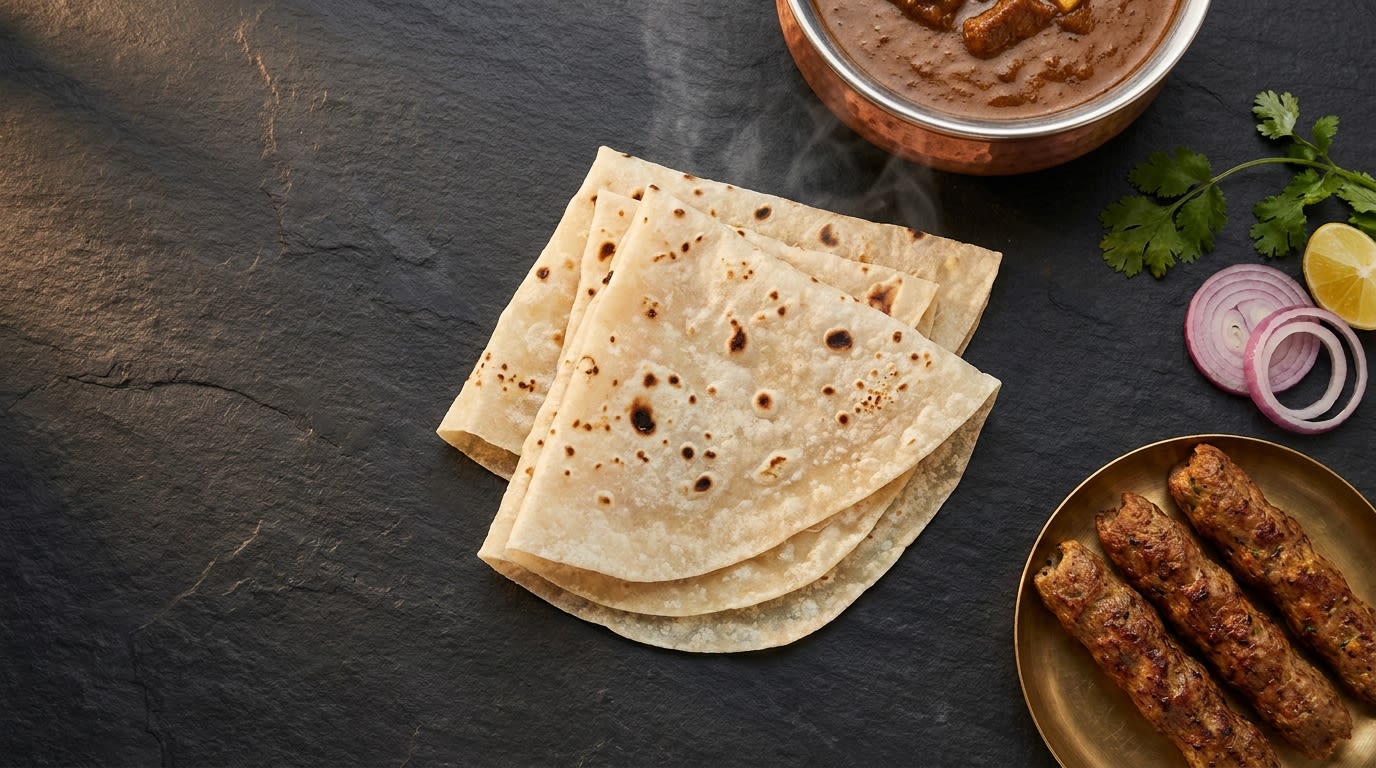
Order a plate of galouti kebab at a good Lucknowi restaurant and it arrives with a folded square of bread beside it, thin enough that you can almost see the plate through it. That’s rumali roti — rumal meaning handkerchief — and the comparison is not an exaggeration. Done properly, it’s one of the thinnest breads in the world.
It’s also one of the hardest to make at home, which is exactly why it moves so well through Indian grocery stores in Australia.
What makes rumali roti different
Most Indian flatbreads are rolled and cooked on a flat or slightly concave tawa. Rumali roti is neither.
The dough is worked far longer than for a chapati — a soft, high-hydration dough, often with a little milk or oil, kneaded until it’s elastic enough to be stretched rather than just rolled. Skilled cooks toss and spin it in the air like pizza dough, thinning it to something close to translucent.
Then it’s cooked on an inverted tawa — a domed griddle, convex side up. The curve lets the enormous sheet of dough drape over the heat and cook in seconds. It puffs, blisters, picks up a few dark spots, and comes off the heat still pliable. Fold it into quarters and it looks like a folded handkerchief.
The whole thing takes maybe twenty seconds of cooking and years of practice. That’s the gap that a well-made packaged version fills.
Why it works with Indian food
Rumali roti’s job is different from a paratha’s. A paratha is rich, layered and substantial — it’s part of the meal. Rumali roti is deliberately neutral and almost weightless. It exists to carry something else.
That makes it the standard pairing for:
Kebabs. Seekh, galouti, boti — anything where the meat is the point and the bread shouldn’t compete.
Rich Mughlai gravies. Korma, nihari, butter chicken. The thinness means you taste the gravy, not the bread.
Dal and dry sabzi. Lighter than a naan, less filling than a paratha, and it doesn’t need ghee to be good.
Chaap and tikka. Which brings us to the second product in the range.
The Amba Foods rumali roti range
We supply rumali roti in three formats across Australia, each aimed at a different buyer.
Rumali Roti — 1Kg pack
Our Rumali Roti is made in Melbourne using traditional technique and supplied in 1Kg packs. This is the volume format — built for Indian grocery stores, restaurants and caterers who move bread consistently rather than occasionally.
The 1Kg pack is what most of our restaurant and catering customers order. It’s priced for foodservice, it stores well, and it’s the format that makes sense when rumali roti is a fixture on your menu rather than an experiment.
Roomali Roti Soya Champ — 700g, 20 pieces
Our Roomali Roti Soya Champ is a complete ready-to-heat meal — tender soya chaap in a rich aromatic gravy, served with soft roomali roti. Twenty pieces per 700g pack, no artificial preservatives, ready in minutes.
This one has done unexpectedly well, and the reason is straightforward: it solves the vegetarian restaurant-meal problem in a single SKU. Soya chaap has a serious following among North Indian vegetarians in Australia, and pairing it with roomali roti in one pack means the customer isn’t assembling a meal from three purchases.
For grocers, it sits naturally in the ready-to-heat freezer alongside our Pav & Bhaji and Aloo Tikki.
Retail multi-pack — 5 pieces
We also distribute a smaller frozen retail format — five paper-thin rotis per pack, sized for a single household meal. This is the entry point for the customer who wants restaurant-style bread at home without committing to a kilo of it.
It’s the format that converts curious buyers into repeat ones, and it belongs on the shelf next to the larger packs rather than instead of them.
Serving and handling
A few things that make the difference between rumali roti that impresses and rumali roti that disappoints:
Heat it briefly and gently. Rumali roti is already cooked. A hot tawa for a few seconds per side is enough. Overheating dries it out and it turns brittle — the opposite of what the bread is for.
Keep it covered. Once heated, stack it under a cloth or in a covered container. Exposed to air it stiffens fast.
Don’t refreeze. Partial thawing and refreezing wrecks the texture in thin breads more than in any other frozen category. One bad experience loses the customer for good.
Serve it folded. The quartered handkerchief fold isn’t decoration — it keeps the bread warm and pliable at the table.
Our Range
Browse Our Full Product Range
750+ authentic Indian food products — sweets, snacks, ready-to-heat meals and more. Available at Indian grocery stores across Australia.
View All ProductsFor grocers, restaurants and caterers
Rumali roti sits in a useful commercial position. It’s premium enough to carry a margin, familiar enough that customers don’t need convincing, and difficult enough to make at home that there’s no realistic substitute.
Some patterns worth planning around:
It sells against restaurants, not against other breads. The customer buying rumali roti is often choosing between cooking at home and going out. That’s a much better competitive position than fighting for share against roti and paratha.
Two formats beat one. Stocking both the household pack and the bulk pack captures the retail customer and the caterer from the same freezer space.
It pulls a full basket. Bread is rarely the whole shop. A rumali roti buyer is buying gravy base, paneer or chaap, pickle and often sweets. Our guide on stocking an Indian grocery store in Australia covers the adjacency logic in detail.
Demand is steady, not seasonal. Unlike festive sweets, bread volume holds through the year — useful for smoothing out the peaks and troughs of a festival-driven catalogue.
Amba Foods supplies independent Indian and Pakistani grocery stores, multicultural supermarkets, restaurants and caterers across Australia, with our own manufactured range and distributed lines consolidated into a single delivery.
Wholesale Supply
Stock Amba Foods Products in Your Store
Wholesale supply for retailers, restaurants and caterers across Australia. Competitive pricing, reliable delivery.
Wholesale EnquiryA bread worth doing properly
There’s a version of rumali roti that’s just a thin, dry disc in a plastic sleeve, and there’s a version that comes off the tawa still soft, blistered where it should be, and folds without cracking. The difference is entirely in the dough and the handling, and customers can tell within one bite.
That’s the standard worth holding a supplier to — including us.
Get in Touch
Have Questions? We're Here.
Call us on 1300 790 350 or send us a message — our team responds within 1 business day.
Contact Us