











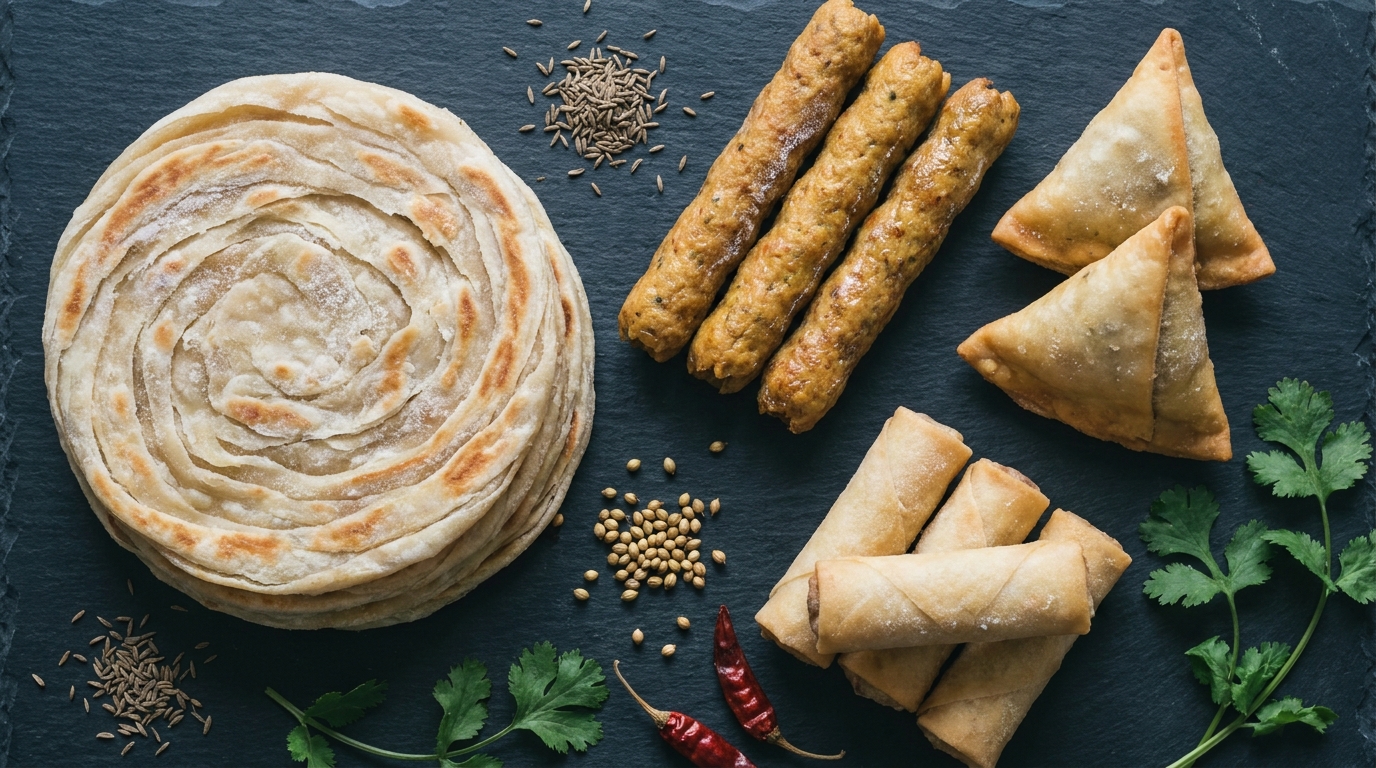
Walk into any Indian or Pakistani grocery store in Melbourne, Sydney or Perth and the freezer aisle tells a story. Twenty years ago it held little more than peas and a few boxes of samosa. Today it carries laccha paratha, seekh kebab, chapli kebab, spring rolls and a dozen varieties of ready-to-fry snacks — much of it Pakistani in origin, and much of it moving faster than the shelf-stable products beside it.
Mazedar sits squarely in that shift. As a Pakistani frozen food brand distributed in Australia, it covers the everyday categories South Asian households reach for most: breads, kebabs, pastry snacks and heat-and-serve items.
Why Pakistani frozen food found an Australian audience
Australia’s Pakistani-born population has grown steadily, and the broader South Asian community — Indian, Pakistani, Bangladeshi, Sri Lankan — shares enough culinary overlap that products cross over easily. A frozen paratha is not a Pakistani product or an Indian product in a suburban Melbourne freezer. It’s just breakfast.
That crossover is why the frozen range in most South Asian grocery stores now sits as a single unified section rather than being split by country of origin.
Three things drove the category:
Time. A hand-rolled paratha takes twenty minutes of active work. A frozen one takes four minutes in a pan and is close enough on a weekday morning.
Consistency. Commercial production means the same layering, the same thickness, the same result every time — something home cooking rarely delivers under time pressure.
Halal certification. For a significant share of the customer base, halal sourcing isn’t a preference but a requirement. Pakistani brands built around halal supply chains removed that friction entirely.
The Mazedar range
The catalogue breaks into four working categories:
Breads and parathas
Laccha paratha, plain paratha and roti make up the volume lines. These are the products that turn a first-time buyer into a repeat customer — low price point, high frequency, minimal cooking skill required.
Kebabs and meat items
Seekh kebab, chapli kebab and shami kebab. Higher margin, and typically bought for weekend cooking or entertaining rather than weekday meals.
Pastry and snack items
Samosa, spring rolls and similar fried snacks. These compete directly with Indian equivalents on the same shelf — our own Punjabi Samosa sits in the same freezer in many stores — and the differentiator is usually spicing profile and filling style rather than format.
Ready-to-heat
Prepared curries and rice dishes for the single-person and small-household market — a segment that has grown noticeably with international student and young professional populations in inner-city Melbourne and Sydney.
What retailers should know
Frozen food is a commitment. It demands freezer space, cold-chain discipline and faster stock rotation than dry goods. But the numbers usually justify it.
Freezer space earns more per square metre than most dry-goods sections in South Asian grocery, because the basket size is larger and the repeat rate is higher.
Cross-selling works. A customer buying frozen paratha is a customer buying pickle, yoghurt and chai. Positioning frozen near complementary categories lifts the whole basket. Our guide on how to stock an Indian grocery store in Australia covers the adjacency logic in more detail.
Stock breadth beats stock depth early on. Carry one SKU across many categories before going deep on any single line. Let the sell-through data tell you where to expand.
Cold chain is non-negotiable. Partial thawing and refreezing destroys texture in laminated breads especially. A single bad paratha experience loses the customer for the brand, not just the batch.
Stocking Mazedar through Amba Foods
Amba Foods distributes Mazedar alongside our own manufactured range and other partner brands, which means retailers can consolidate frozen and ambient ordering into a single delivery. For independent grocers running tight margins, fewer suppliers means less admin, fewer minimum-order thresholds and better freight economics.
We supply independent Indian and Pakistani grocery stores, larger multicultural supermarkets, restaurants and caterers, and convenience retailers testing the category for the first time.
Wholesale Supply
Stock Amba Foods Products in Your Store
Wholesale supply for retailers, restaurants and caterers across Australia. Competitive pricing, reliable delivery.
Wholesale EnquiryThe direction of travel
The frozen South Asian category in Australia is still early. Compare it to the frozen Italian or Chinese sections in a mainstream supermarket and the gap is obvious — those categories have shelf space in Coles and Woolworths that South Asian frozen food has barely begun to claim.
That’s changing. Mainstream retailers are testing South Asian frozen lines, and the products winning shelf space are the ones with consistent quality, reliable supply and packaging that reads clearly to a shopper who has never cooked the dish before.
For grocers, the opportunity right now is being established in the category before the mainstream players compress the margins.
Get in Touch
Have Questions? We're Here.
Call us on 1300 790 350 or send us a message — our team responds within 1 business day.
Contact Us